 Skolera LMS Blog Educational Technology Articles and News

The erp for schools has become a strategic necessity for every educational institution seeking greater organization, higher efficiency, and a comprehensive overview of all academic and administrative details. With the significant expansion in student numbers and the multitude of tasks assigned to specialists, it is no longer sufficient to rely on traditional systems to manage daily operations, track performance, or communicate with parents. The school ERP system provides a unified platform that connects all departments—from registration, admissions, and attendance to schedules, reports, warehouses, and human resources. This ensures faster, more accurate decision-making and enhances the quality of the educational process.
Table of Contents
Definition of erp for schools:
The erp for schools is a comprehensive system that consolidates all school operations on a single platform, enabling integrated management of students and teachers. It aims to improve efficiency, reduce errors, and provide clear visibility to decision-makers. Based on this:
- Student management: The system accurately tracks enrollment, schedules, attendance, grades, and academic records to ensure a structured educational experience.
- Teacher management: The system organizes schedules, assessment data, class distribution, and performance reports flexibly and efficiently.
- Human Resources (HR) Management: Tracks hiring, teacher and employee files, contracts, salaries, and leave within one centralized system.
- Warehouse Management: Monitors items and inventory, adds and removes school tools and supplies, and accurately tracks consumption to reduce waste.
- Financial Resource Management: The system is used to process invoices, expenses, salaries, and budgets with a precise methodology that increases transparency and supports decision-making.
Why Schools Need an ERP System?
The erp for schools has become a real necessity because it gives school administrations a clearer view of data and improves operational efficiency. The use of erp software for schools also improves decision-making and strengthens communication between departments. Key advantages include:
- The system helps centralize and consolidate data into a single platform, which improves the speed of access to information and reduces paperwork errors.
- The system improves scheduling and organization by accurately managing schedules and exams and sending real-time notifications for any changes.
- The system provides live reports on student attendance, achievement, and behaviour, which supports quick and accurate decision-making.
- The system enhances communication between students, teachers, and administrators by connecting them to a single system, which speeds up information exchange.
- The system improves the management of fees, salaries, and expenses through accurate financial reports that reduce waste and support sound planning.
READ MORE ABOUT: Student Administration Software for Modern School Management
How ERP for Schools Centralizes Academic and Administrative Operations?
The erp for schools has become the cornerstone of modern management because it combines academic and administrative procedures in a single platform that facilitates data control, speeds up decision-making, and increases operational efficiency. Its value is clearly visible in the following ways:
- Consolidates student, teacher, and class data into a central database that prevents errors and facilitates immediate access to information.
- Using the education erp system to manage schedules and exams with instant updates that prevent any conflicts.
- Tracks attendance, grades, and behaviour through immediate reports that support quick and accurate decision-making.
- Links student affairs, finances, and employee affairs in one system, minimizing delays and increasing harmony between departments.
- Manages fees, expenses, and salaries professionally through accurate financial reports that support planning and reduce waste.
READ MORE ABOUT: What is a Student Record Management System and How It Works?
Core Modules of an ERP for Schools:
The erp for schools unifies daily operations into a single platform that gives management greater control over resources and reduces operational chaos. It is easy to understand how its various components contribute to the complete organization of the administrative structure:
- Warehouse management through tracking tools and supplies and automated inventory with early alerts for stock shortages to enhance operational continuity.
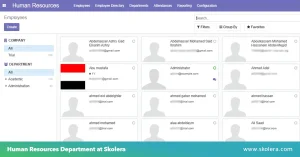
- Human resources management for attendance, payroll, contracts, leave, and performance evaluation within accurate and organized digital files, as shown in the Skolera HR panel.
- Financial resource management by integrating fees, expenses, budgets, and invoices into a unified system that provides clear visibility into cash flows through the best erp for schools.
- Electronic registration and admission, from receiving applications to uploading documents, scheduling interviews, and automatically creating student files.
- Support units, including the library, school transportation, and maintenance, work in complete harmony to ensure stable daily operations and reduce wasted time.
READ MORE ABOUT: The Ultimate Guide to Online Learning Management Platforms
Key Features to Look for in an ERP for Schools:
The erp for schools has become a pivotal component for institutions looking to improve efficiency and gain greater control over its data. It consolidates processes into a single platform and reduces operational chaos. With this foundation in place, however, key features emerge:
- A unified dashboard that displays student and employee data, attendance, and grades in real time, with easy filtering and analysis.
- Advanced academic management that includes schedules, exams, assessments, and cumulative reports with instant updates that prevent conflicts.
- A comprehensive financial system for fees, payments, invoices, and expenses with accurate reports that help management make informed financial decisions.
- Human resources management that includes attendance, payroll, contracts, and leave within organized digital files that are easy to update.
- Effective communication tools that connect teachers, students, and parents with instant notifications and continuous updates for better educational follow-up.
READ MORE ABOUT: The Best Solution for Student Data Management – Skolera
Why Skolera Is the Right ERP Solution for Schools?
The erp for schools is no longer just an administrative system, but has become a fundamental pillar for developing the educational experience. Skolera is one of the most capable solutions for integrating learning and administration, especially with the following features:
- New student registration: The system facilitates the registration process through simplified steps that allow parents to upload documents and follow up electronically.
- Student affairs management: Creates comprehensive digital files containing student personal and academic data with the ability to modify the stage or grade while retaining all previous records.
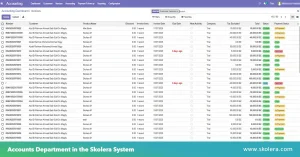
- Accounts management: The system provides an integrated financial system for fees, invoices, collections, expenses, budget preparation, and accurate financial reports to ensure complete transparency.
- Inventory management: Tracks items and their movement, records inputs and outputs, sends alerts for low stock, and assists in accurate inventory management to ensure stable operation.
FAQ:-
How does an ERP system support school administration?
An ERP system supports school administration by consolidating all academic and administrative processes into a single platform. It manages student data, schedules, attendance, exams, human resources, finances, inventory, and communications, which reduces errors, increases efficiency, and helps administrators make faster decisions based on accurate data.
Is an ERP system suitable for both public and private schools?
Yes, an ERP system is suitable for public and private schools because it is flexible and customizable to the size of the institution, number of students, and nature of the curriculum and required processes. Its modules and settings can be modified to suit each educational environment to ensure smooth management regardless of the type of school.
Can an ERP system manage student information and admissions?
Absolutely. The ERP system can manage the entire student lifecycle, from online applications, uploading documents, review and approval, then creating a digital student file that includes student data, attendance, grades, and behaviour, with easy tracking through the different stages of study.