 Skolera LMS Blog Educational Technology Articles and News

Can educational institutions achieve greater efficiency and provide a better learning experience without increasing administrative burdens? With the rapid pace of digital transformation, automation in the education sector has become one of the most important factors helping schools and universities improve performance and streamline daily operations. Automation in the education sector refers to the use of digital technologies to automatically perform repetitive tasks, such as attendance management, assessment, and communication. This approach helps reduce human error, and improve data accuracy, giving educational administrators and teachers more opportunity to focus on developing the educational process and achieving the best outcomes for students.
Table of Contents
What Is the Automation in Education Sector:
Walk into any school today, and you will see something different. Automation in the education sector has quietly taken over the tasks that used to consume hours. It’s not replacing teachers, it’s just clearing the clutter. Here’s what’s been added:
- Attendance used to mean five minutes of calling out names in every class. Now it’s a quick scan or tap, and it’s done in an instant.
- No one likes grading forty identical quizzes at midnight. The automated tools do the repetitive scoring, students get immediate feedback, and teachers get their evenings back for meaningful lesson planning.
- Parents used to learn about missed homework later. Today’s learning platforms automatically track progress and notify parents.
- Behind the scenes, scheduling and enrollment used to involve stacks of paperwork. Now, it’s digital for the most part. There are fewer errors, and staff aren’t buried in forms.
Key Areas of Automation in the Education Sector:
Automation in the education sector encompasses several key areas that help schools improve operational efficiency and streamline daily procedures. The most notable of these areas include:
Administrative Process Automation:
Administrative process automation focuses on reducing routine tasks by digitizing registration and admission procedures, as well as managing schedules and documents, which helps save time and minimize errors.
Attendance and Student Tracking Automation:
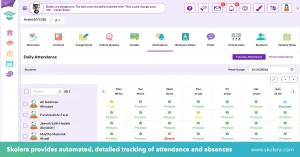
Attendance and student tracking automation helps record attendance data accurately, and enables monitoring of student performance. For example, Skolera provides advanced digital tools for managing attendance in real time.
Assessment and Grading Automation:
Automating assessment speeds up grading processes and improves the accuracy of results, as teachers can receive immediate reports on student performance.
Communication and Notification Systems:
Digital communication tools play a fundamental role in strengthening connections among all stakeholders in the educational process.
Data Management and Reporting Automation:
No educational automation system is complete without advanced data management and analysis solutions.
Data management and reporting automation collects and analyzes educational information in a structured manner.
read more about: Best Classroom Management Software for Teachers and Schools
How Automation Improves Operational Efficiency in Schools:
Automation in the education sector helps eliminate routine tasks and make more effective use of available resources, and education automation has also become an effective tool for improving operational performance and achieving higher levels of efficiency within schools. Among the key ways automation contributes is:
- Reducing the time spent on daily administrative processes: By automating repetitive tasks such as data entry, request management, and record-keeping.
- Improving workflow efficiency: Automated systems help facilitate faster and more accurate information exchange between different departments, reducing delays and enhancing coordination.
- Improving data accuracy and reducing errors: Automation minimizes errors resulting from manual data entry, ensuring more reliable and accurate information for decision-making.
- Enhancing responsiveness to various requirements and tasks: Automated systems enable the immediate execution of procedures and the sending of notifications and updates, helping to meet the needs of students, and teachers more efficiently.
read more about: Learning Management System in Education for Modern Schools
The Impact of Automation on Teaching and Learning Outcomes:
The benefits of automation in the education sector are not limited to administrative aspects alone; they also extend to supporting the educational process and improving learning outcomes.
Among the most notable positive impacts of automation on the educational process are the following:
- Providing teachers with more time to focus on educational activities: As the need to perform repetitive administrative tasks manually decreases, teachers have more opportunities to develop educational content and interact with students.
- Supporting personalized learning: Automation tools help collect and analyze academic performance data, enabling the delivery of educational experiences tailored to each student’s needs.
- Improving academic performance tracking: Through real-time reports and analytics, teachers and educational administrators can assess student progress and take appropriate actions.
- Enhancing Interaction and Engagement: By providing digital tools that facilitate communication and the management of educational activities, thereby encouraging students to participate.
read more about: School Management Software for Smarter School Operations
Challenges in Implementing Automation in the Education Sector:
Despite the significant benefits that automation in the education sector offers, some institutions may face challenges when implementing it. The most notable of these challenges include:
- High initial costs associated with systems: Schools may need to make financial investments in the software, infrastructure, and hardware required to implement automation.
- The need to train staff to use the new solutions: The success of automation requires training programs that help users take full advantage of digital systems.
- Data protection and digital privacy: Institutions need to implement robust security measures to ensure the protection of student and teacher data and compliance with privacy regulations.
- The difficulty of integrating modern systems with legacy systems: Some institutions may face technical challenges when attempting to connect new solutions with previously used systems.
Despite the significant benefits offered by school automation solutions, their successful implementation depends on good planning.
Key Considerations Before Adopting Automation Solutions:
Before investing in automation in the education sector, educational institutions must carefully assess their needs and goals.
To ensure the best results, the following points should be considered:
- Identify the problems and challenges the institution seeks to address: Understanding the institution’s actual needs helps in selecting automation solutions that deliver the best value and support educational goals.
- Select solutions that are flexible and scalable as the institution grows: It is important to adopt systems that can be developed and enhanced with new features as user numbers increase or operations expand.
- Ensure systems comply with regulations and security requirements: Solutions must adhere to data protection standards and support compliance with applicable policies and regulations.
- Prioritize ease of use and provide necessary training for users: Selecting user-friendly systems and providing appropriate support and training helps accelerate adoption and maximize the benefits of the solutions.
read more about: Student Performance Report for Smarter School Decisions
How Skolera Supports Automation in the Education Sector:
Skolera offers a comprehensive School Management System with a suite of automation tools that support various aspects of the education sector. The platform leverages automation in the education sector to streamline administrative processes, enhance educational management, and improve the overall learning experience. Key features include:
- Creating educational content: The system helps teachers easily create educational content, whether it is audio, text, or video.
- Curriculum Planning: The system helps create a curriculum plan, saving teachers significant time to achieve educational goals and manage classes efficiently; this plan serves as a reference for teachers to consult.
- Test Creation: The system assists in creating tests that cover all parts of the curriculum. The system also includes seven types of questions, which helps ensure fair assessment of students.
- Ease of Communication: The system helps teachers communicate with students, whether individually or in groups. It also offers a posting feature, which facilitates the exchange of ideas between them and helps them prepare for the next lesson.

FAQ:
Why is automation becoming important in modern schools?
Automation has become important in modern schools because it helps reduce repetitive administrative tasks, improves data accuracy, and frees up time for teachers and administrators to focus more on the educational process and enhancing the student experience.
Can automation improve schools?
Yes, automation can improve school performance by streamlining daily operations such as attendance and grade management and communication with parents, as well as providing accurate reports that help inform more effective educational and administrative decisions.
How secure are automated education systems?
Modern educational automation systems rely on advanced data protection technologies, such as encryption, user permissions management, and regular backups. However, the level of security also depends on the quality of the system used and the educational institution’s adherence to cybersecurity best practices.